Remembering Evelyn Dean – a tribute by Clare Durance

It was with great sadness that we heard of Eve’s death in mid-September.  She died peacefully at home, apparently in her sleep.

Many of us have since thought that this gentle slipping away without causing fuss or bother to anyone was completely typical of the Eve we knew and had grown so very fond of.

I first met Eve shortly after we moved to Wivenhoe 50 years ago.  She and Steve were firm friends of ours from those early days. Some of the early Shakespeare plays directed by Sheila Foster were performed in Ten Acres, now Palmer Gardens, which belonged to Eve’s in-laws, Hally and Ted Palmer.  She and Steve were loyal supporters of the group and always to be found in the audience of every play.

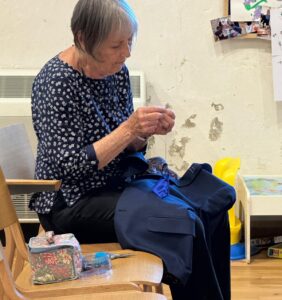
When Steve died, I asked Eve if she would join the Front of House team for the production of Pericles.  After this, she became an invaluable member of our costume team.  Eve had an artist’s eye for detail, and she loved nothing better than a challenge.  Many of us will remember being rescued by her to deal with awkward headgear, or wings or a dress that didn’t fit anywhere.   She would tackle any job calmly and quietly and miracles would just happen.  It is particularly wonderful that she and Margie North worked together on the recent production of “All’s Well That Ends Well” and won the award for best costume from the North East Essex Guild.

Eve’s funeral will be on Tuesday 21st October at 12.30 p.m. at Weeley Crematorium. I know that many of us will want to attend to say goodbye to such a good friend.

Meeting Nora Williams – in conversation with Diane Spivey

Hello Nora!

Welcome to Wivenhoe Open-Air Shakespeare as our new director for 2026 – we are looking forward to getting to know you. What made you want to direct a play for our group?

Thank you so much for inviting me to be involved! I am so excited to have the opportunity to direct this play, with this group of people. Community theatre is more important than ever in our age of AI and misinformation and suspicion of our neighbours. Getting people together to create something, and sharing that with the community, is one of the most important things we can do. I love the way that WOAS incorporates music into their shows, too, and I appreciate your track record of performing Shakespeare’s less popular plays. I really enjoyed All’s Well That Ends Well this past summer, and I can’t wait to get stuck in with Richard II.

Why Richard II?

Shakespeare’s history plays are underrated, and Richard II, in particular, is more than meets the eye. My friend Dr Ambereen Dadabhoy compares this play to Mean Girls – there’s a lot of general cattiness that is so much fun. At the same time, there’s a great deal of salience in this story for the modern world: incompetent and selfish leadership and political squabbling are front and centre, and both Richard and Bolingbroke are flawed as leaders. If you’re a lower-class character in this story – or even one of the more minor lords – it feels like there are no good outcomes. Imagining Richard as a direct analogue for, say, Donald Trump is over-simplifying things – but those contexts are certainly present when I look at what this play might have to say today.

Why is it a good play to get involved in as cast or crew?

I love this script because there’s truly a part for everyone – there are about 40 characters, depending on how you count the soldiers and servants. If you’re nervous about having lots of lines, we’ve got you covered! But, equally, if you’re keen to take on a challenge, this play has some of the most beautiful poetry. I’m contemplating some gender play with a couple of the key characters – specifically Bolingbroke – so watch this space!

What is your background, and what inspired your passion for Shakespeare and his plays?

I benefitted from the vibrant local theatre scene in my hometown of Buffalo, New York. One of my first gigs as a teenager was with Shakespeare in Delaware Park, Buffalo’s equivalent of WOAS, which celebrated its 50th season this year!  I went on to drama school in Toronto, before moving to the UK to pursue a masters in Staging Shakespeare at Exeter. From there, I applied for PhD funding mostly so I could keep hanging out with this cute British guy… I don’t recommend it to young people as a life plan, but it worked out for us! We’ve been married seven years this year. Currently, I work for BIMM University, a small and specialist institution focused on the creative industries.  Recently I’ve been directing A Two Woman Hamlet – we’ll be at Colchester Fringe 24-29 October https://colchester.ssboxoffice.com/events/a-two-women-hamlet/

How would you define your style of direction? What are your hopes for the whole process of rehearsing and performing?

I’m a highly collaborative director – I’ll have my toolbox of techniques and approaches, but what I really want to know is what the actors and the creative team are going to bring into the room. My favourite phrase in rehearsal is, ‘let’s try it’. I love being in a room where I’m surprised by the actors, and I do my best to create a space where we’re all empowered to take those creative risks and challenge ourselves. Overall, I hope that we’ll have a lot of fun, we’ll all learn something new, and we’ll put together a great show.

Do you act as well as direct?  Do you have a favourite Shakespeare character or play?

I don’t do so much acting anymore, although I sing with Colchester Choral Society. My favourite character and my favourite play from the early modern period are actually not written by Shakespeare. I love Moll Cutpurse from Thomas Middleton and Thomas Dekker’s The Roaring Girl – she’s fascinating and fun to play. My favourite play at the moment is William Rowley, Thomas Dekker, and John Ford’s true-crime tragicomedy The Witch of Edmonton.

Tell us something else about yourself that we might not know.

I recently published my first book! Canonical Misogyny: Shakespeare and Dramaturgies of Sexual Violence came out with Edinburgh University Press in late 2024.

Richard II will be performed in St Mary’s Churchyard, Wivenhoe at the end of June 2026. Read-throughs and auditions will be in February/March 2026. Follow our Facebook page or contact us for further details.

Bertram and Edward, Earl of Oxford


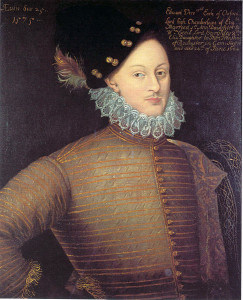
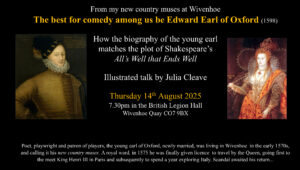
In August many of us attended an evening at the Royal British Legion jointly hosted by Wivenhoe Open-Air Shakespeare and Wivenhoe History Group. The speaker was noted Shakespearean expert Julia Cleave who talked about the parallels between the character Bertram in All’s Well That Ends Well, and the real-life Edward, 17th Earl of Oxford, who lived for some time here in Wivenhoe. Both ran away to fight in foreign wars fleeing arranged marriages; both were wards of the King of France – the similarities were fascinating.

Julia has done an impressive amount of historical research and this talk could only scratch the surface, so she’s passing on the following link. So, if you want to find out more about the brothers Dumaine or Spurio and the Spinii, do take a look!
 
[from Julia] The Shakespearean Authorship Trust has been holding annual November conferences since 2003, originally at the Globe, but latterly at the newly refurbished Marylebone Theatre.
Here is the session on All’s Well from 2014 which includes the extract from Act IV with Sir Derek playing Bertram, Richard Clifford both Captain Dumaines, Angus Wright the Soldier, and Mark Parolles.
 

ALL’S WELL BY NUMBERS – notes from the props team

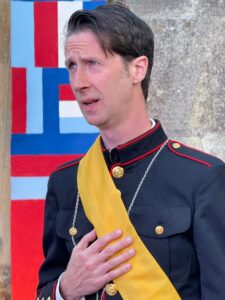
‘I have tonight dispatched sixteen businesses,’ says Bertram in Act 4 of All’s Well That Ends Well. He goes on to list all he has achieved, including mourning his dead wife, seducing a young woman and writing home to his mother.  Sixteen – an interesting number to choose for one’s to-do list, but it does convey a sense of hectic business.  It seems that Shakespeare chooses very precise numbers to create a sense of magnitude.  The First Lord tells Parolles ‘seventeen poniards are at thy bosom’.  We can’t manage that number of lethal weapons on stage (or soldiers to wield them), but I doubt Shakespeare’s company did either.  Perhaps an audience finds it easier to believe the size of the ambush if such a specific number is mentioned.  It was, however, a relief to know that the props team didn’t need to take this literally. We do have quite a few letters to create or source – the Florentines and the French kept up their correspondence daily and no fewer than nine letters are mentioned in the script, from military communications with the king of Austria to Diana’s petition to the king of France.  Again, we’ve decided simply to refer to some of them, to reduce the number needed on stage.  It could be a nightmare if the wrong actor picked up the wrong letter from the props table backstage.  Our story could end up developing very differently!  

But smaller numbers can bring their own issues.  There are only two rings in All’s Well, but the story of Helen and Bertram relies on the exchange of these rings at key points in the play.  Keeping tabs on these two different rings is quite a challenge – the Countess gives one to Bertram, who gives it to Diana, who gives it to Helen.  Meanwhile the other ring is given by the King to Helen who gives it to Bertram (but he thinks it is Diana…).  So, keep your eyes on those rings and concentrate – there may be a test at the end!  

We have needed to source a single drum, which is the linchpin of the sub-plot in which Parolles, a boastful soldier, loses his beloved drum in battle: ‘But a drum! Is’t but a drum? A drum so lost!’ Persuaded to try to retrieve it from the enemy, he is ambushed and shown up as a coward and traitor.  But even Parolles renounces this drum by the end ‘A plague on all drums!’ As our Parolles practises his drum rolls at home, we suspect his family may feel very similarly.

One drum, two rings, two blindfolds, nine letters – all these we can manage. But sixteen businesses, seventeen poniards, three thousand crowns, five or six thousand soldiers on horse and fifteen-thousand foot soldiers – we are going to have to ask you to use your imagination!

Diane Spivey, Assistant Director

All’s Well That Ends Well will be performed at St Mary’s Churchyard, Wivenhoe at 7.30pm from June 24th to 28th. Tickets (from May 14th) from Wivenhoe Bookshop (cash only) or online at Ticketsource. 

https://www.ticketsource.co.uk/allswellthatendswell