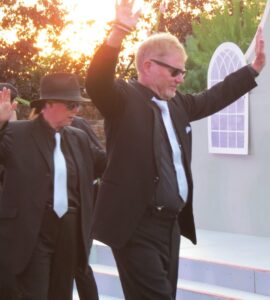
The Barred Bard by John O’Brien

Shakespeare walked into a pub…

…And the landlord said “Get out,  you’re Bard.”

She didn’t laugh.  In truth she was a little fed up of me returning from my Friday bike ride a bit worse for wear, after rehydrating in the pub. “Why don’t you go to these Shakespeare Workshops, held every Friday evening by the erudite members of the Wivenhoe Open Air Shakespeare Group?  You might learn something”. The idea did appeal to me.  The little I knew about Shakespeare’s plays came from English O level, more than half a century earlier, and a workshop sounded about right. I wouldn’t be expected to read, or act or humiliate myself in a new and unforeseen way, would I?

That was over three years ago and since then I have appeared in three successive productions. In the first (Much Ado about Nothing) I played a drunken thug called Borachio, the second (All’s Well That Ends Well) saw me tread the boards as a cowardly, preening thug called Parolles and in the latest production of Richard II,  I played Northumberland: a thug. After each play, I have sworn never to do that again. So, what is it that causes me to return to the scene of so much personal angst?
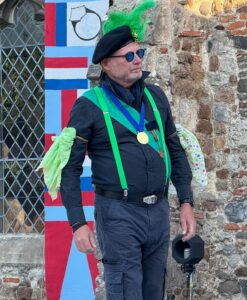
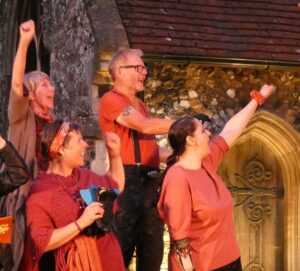
The simple answer is, of course, my fellow players and the camaraderie you feel when a diverse group of people strive together to produce an event, perfect a product, score a goal.

The process feels very similar to playing for a football team. It starts with knowing the objective. What play is going to be performed?  Who will play in each position?  Do we have faith in the manager?  Then comes the bi-weekly training, the self-doubt, the learning from others, the being match-fit and, of course, the singing.  

Nothing would happen without a back-room team that makes it all happen. Everyone joins in with that. The kit (costumes), preparing the playing field (the stage), crowd control (front of house), the stands (white plastic chairs do not appear by magic) and a hundred and one things that are necessary to make a premier division team. Including regular sessions with a counsellor (going to the pub)!

Eventually, we have a week of cup finals. The atmosphere in the changing room is febrile, lots of pacing about and worried looks.  Finally we march out behind the band and the crowd goes wild claps politely. And so it begins. We have our individual stars, of course. Those personalities who can turn the game on its head with a simple sneer, or an archly-raised eyebrow, but it’s teamwork that wins the day – five nights in a row.   I do think that after the week of shows we should tour Wivenhoe in an open-top bus.

In short, the WOAS group is a friendly, hardworking, supportive, talented group of individuals who join together to create a team capable of winning the world cup.

I wonder if there are any roles for a thug in next summer’s King Lear?
This article was first published in the Autumn 2026 edition of Wivenhoe News.

ALL’S WELL BY NUMBERS – notes from the props team

‘I have tonight dispatched sixteen businesses,’ says Bertram in Act 4 of All’s Well That Ends Well. He goes on to list all he has achieved, including mourning his dead wife, seducing a young woman and writing home to his mother.  Sixteen – an interesting number to choose for one’s to-do list, but it does convey a sense of hectic business.  It seems that Shakespeare chooses very precise numbers to create a sense of magnitude.  The First Lord tells Parolles ‘seventeen poniards are at thy bosom’.  We can’t manage that number of lethal weapons on stage (or soldiers to wield them), but I doubt Shakespeare’s company did either.  Perhaps an audience finds it easier to believe the size of the ambush if such a specific number is mentioned.  It was, however, a relief to know that the props team didn’t need to take this literally. We do have quite a few letters to create or source – the Florentines and the French kept up their correspondence daily and no fewer than nine letters are mentioned in the script, from military communications with the king of Austria to Diana’s petition to the king of France.  Again, we’ve decided simply to refer to some of them, to reduce the number needed on stage.  It could be a nightmare if the wrong actor picked up the wrong letter from the props table backstage.  Our story could end up developing very differently!  

But smaller numbers can bring their own issues.  There are only two rings in All’s Well, but the story of Helen and Bertram relies on the exchange of these rings at key points in the play.  Keeping tabs on these two different rings is quite a challenge – the Countess gives one to Bertram, who gives it to Diana, who gives it to Helen.  Meanwhile the other ring is given by the King to Helen who gives it to Bertram (but he thinks it is Diana…).  So, keep your eyes on those rings and concentrate – there may be a test at the end!  

We have needed to source a single drum, which is the linchpin of the sub-plot in which Parolles, a boastful soldier, loses his beloved drum in battle: ‘But a drum! Is’t but a drum? A drum so lost!’ Persuaded to try to retrieve it from the enemy, he is ambushed and shown up as a coward and traitor.  But even Parolles renounces this drum by the end ‘A plague on all drums!’ As our Parolles practises his drum rolls at home, we suspect his family may feel very similarly.

One drum, two rings, two blindfolds, nine letters – all these we can manage. But sixteen businesses, seventeen poniards, three thousand crowns, five or six thousand soldiers on horse and fifteen-thousand foot soldiers – we are going to have to ask you to use your imagination!

Diane Spivey, Assistant Director

All’s Well That Ends Well will be performed at St Mary’s Churchyard, Wivenhoe at 7.30pm from June 24th to 28th. Tickets (from May 14th) from Wivenhoe Bookshop (cash only) or online at Ticketsource. 

https://www.ticketsource.co.uk/allswellthatendswell