A Brief History of Pop-Up – by Helen Chambers

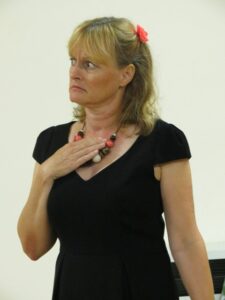
We first Popped Up – experimental workshop style – in October 2012, as part of the WivWords Literary Festival, organised by the brilliant Petra McQueen. We’ve since continued October Pop-Ups under our own steam, every year (barring lockdown year, and last year’s cancellation due to illness).

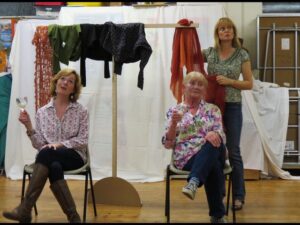
My first experience of directing adults in a play came from Pop-Up in 2013. As a primary school teacher who’d only organised school plays, I was apprehensive, to say the least. I needn’t have been. My experienced and good-natured cast approached my half-formed ideas with enthusiasm and carried me through the process. I set the ‘play within the play’ from A Midsummer Night’s Dream locally on Clacton Beach, with Philostrate as a holiday camp events organiser and Theseus, Duke of Athens, and his new wife Hippolyta, watching from deckchairs. The ‘wall’ was a tatty beach towel, the lion was a children’s inflatable, and the swords were replaced with buckets and spades. The ‘rude mechanicals’ dressed in loud shirts and beach-wear. I was thrilled and gratified when the audience laughed loudly and a lot!

Pop-Up has become one of the three main things WOAS offers, alongside workshops in the winter and our annual summer outdoor production. It’s a marvellous opportunity to cherry-pick scenes and parts we might not otherwise get to try!  Performing is open to group members who’ve been in previous productions and requires independent hard work behind the scenes with only one formal hall-based rehearsal to bring it all together. Past organisers (me included) have likened it to herding cats!

Our aim is to make free-standing Shakespearean scenes accessible and enjoyable, even out of context. We cut and rearrange texts, play with new ideas, and enjoy the challenge of extra line-learning during our ‘close season.’ We’ve had music: a cappella madrigals and recorder consorts, and we encourage experimentation. Many of us have written or adapted our own scenes and we’ve included Shakespeare-related sketches and readings.

Highlights for me include trying out Lady Macbeth in 2015 – and writing and performing in a Cut Price Macbeth in 2023 with Alison and Sara (where we played all the characters and made big use of hats and props).  I’ve always been strongly drawn to comic parts – having an audience laugh at something you’ve said or done is a powerful drug.

This year’s Pop-Up will be performed on Saturday 1 November and Sunday 2 November at 3.30pm at Wivenhoe Congregational Church Hall. Tickets are £6.00 available (cash only) from Wivenhoe Bookshop or from Ticketsource: click here to book.

And if you’d like to become more involved, do come along to one of our workshops – newcomers welcome! Click here to find out more, or check our Facebook page for latest news.


Meeting Nora Williams – in conversation with Diane Spivey

Hello Nora!

Welcome to Wivenhoe Open-Air Shakespeare as our new director for 2026 – we are looking forward to getting to know you. What made you want to direct a play for our group?

Thank you so much for inviting me to be involved! I am so excited to have the opportunity to direct this play, with this group of people. Community theatre is more important than ever in our age of AI and misinformation and suspicion of our neighbours. Getting people together to create something, and sharing that with the community, is one of the most important things we can do. I love the way that WOAS incorporates music into their shows, too, and I appreciate your track record of performing Shakespeare’s less popular plays. I really enjoyed All’s Well That Ends Well this past summer, and I can’t wait to get stuck in with Richard II.

Why Richard II?

Shakespeare’s history plays are underrated, and Richard II, in particular, is more than meets the eye. My friend Dr Ambereen Dadabhoy compares this play to Mean Girls – there’s a lot of general cattiness that is so much fun. At the same time, there’s a great deal of salience in this story for the modern world: incompetent and selfish leadership and political squabbling are front and centre, and both Richard and Bolingbroke are flawed as leaders. If you’re a lower-class character in this story – or even one of the more minor lords – it feels like there are no good outcomes. Imagining Richard as a direct analogue for, say, Donald Trump is over-simplifying things – but those contexts are certainly present when I look at what this play might have to say today.

Why is it a good play to get involved in as cast or crew?

I love this script because there’s truly a part for everyone – there are about 40 characters, depending on how you count the soldiers and servants. If you’re nervous about having lots of lines, we’ve got you covered! But, equally, if you’re keen to take on a challenge, this play has some of the most beautiful poetry. I’m contemplating some gender play with a couple of the key characters – specifically Bolingbroke – so watch this space!

What is your background, and what inspired your passion for Shakespeare and his plays?

I benefitted from the vibrant local theatre scene in my hometown of Buffalo, New York. One of my first gigs as a teenager was with Shakespeare in Delaware Park, Buffalo’s equivalent of WOAS, which celebrated its 50th season this year!  I went on to drama school in Toronto, before moving to the UK to pursue a masters in Staging Shakespeare at Exeter. From there, I applied for PhD funding mostly so I could keep hanging out with this cute British guy… I don’t recommend it to young people as a life plan, but it worked out for us! We’ve been married seven years this year. Currently, I work for BIMM University, a small and specialist institution focused on the creative industries.  Recently I’ve been directing A Two Woman Hamlet – we’ll be at Colchester Fringe 24-29 October https://colchester.ssboxoffice.com/events/a-two-women-hamlet/

How would you define your style of direction? What are your hopes for the whole process of rehearsing and performing?

I’m a highly collaborative director – I’ll have my toolbox of techniques and approaches, but what I really want to know is what the actors and the creative team are going to bring into the room. My favourite phrase in rehearsal is, ‘let’s try it’. I love being in a room where I’m surprised by the actors, and I do my best to create a space where we’re all empowered to take those creative risks and challenge ourselves. Overall, I hope that we’ll have a lot of fun, we’ll all learn something new, and we’ll put together a great show.

Do you act as well as direct?  Do you have a favourite Shakespeare character or play?

I don’t do so much acting anymore, although I sing with Colchester Choral Society. My favourite character and my favourite play from the early modern period are actually not written by Shakespeare. I love Moll Cutpurse from Thomas Middleton and Thomas Dekker’s The Roaring Girl – she’s fascinating and fun to play. My favourite play at the moment is William Rowley, Thomas Dekker, and John Ford’s true-crime tragicomedy The Witch of Edmonton.

Tell us something else about yourself that we might not know.

I recently published my first book! Canonical Misogyny: Shakespeare and Dramaturgies of Sexual Violence came out with Edinburgh University Press in late 2024.

Richard II will be performed in St Mary’s Churchyard, Wivenhoe at the end of June 2026. Read-throughs and auditions will be in February/March 2026. Follow our Facebook page or contact us for further details.