The Barred Bard by John O’Brien

Shakespeare walked into a pub…

…And the landlord said “Get out,  you’re Bard.”

She didn’t laugh.  In truth she was a little fed up of me returning from my Friday bike ride a bit worse for wear, after rehydrating in the pub. “Why don’t you go to these Shakespeare Workshops, held every Friday evening by the erudite members of the Wivenhoe Open Air Shakespeare Group?  You might learn something”. The idea did appeal to me.  The little I knew about Shakespeare’s plays came from English O level, more than half a century earlier, and a workshop sounded about right. I wouldn’t be expected to read, or act or humiliate myself in a new and unforeseen way, would I?

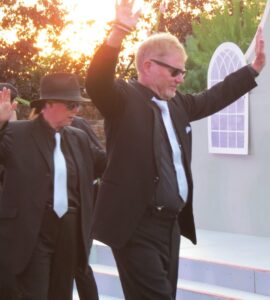
That was over three years ago and since then I have appeared in three successive productions. In the first (Much Ado about Nothing) I played a drunken thug called Borachio, the second (All’s Well That Ends Well) saw me tread the boards as a cowardly, preening thug called Parolles and in the latest production of Richard II,  I played Northumberland: a thug. After each play, I have sworn never to do that again. So, what is it that causes me to return to the scene of so much personal angst?
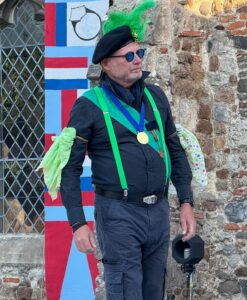
The simple answer is, of course, my fellow players and the camaraderie you feel when a diverse group of people strive together to produce an event, perfect a product, score a goal.

The process feels very similar to playing for a football team. It starts with knowing the objective. What play is going to be performed?  Who will play in each position?  Do we have faith in the manager?  Then comes the bi-weekly training, the self-doubt, the learning from others, the being match-fit and, of course, the singing.  

Nothing would happen without a back-room team that makes it all happen. Everyone joins in with that. The kit (costumes), preparing the playing field (the stage), crowd control (front of house), the stands (white plastic chairs do not appear by magic) and a hundred and one things that are necessary to make a premier division team. Including regular sessions with a counsellor (going to the pub)!

Eventually, we have a week of cup finals. The atmosphere in the changing room is febrile, lots of pacing about and worried looks.  Finally we march out behind the band and the crowd goes wild claps politely. And so it begins. We have our individual stars, of course. Those personalities who can turn the game on its head with a simple sneer, or an archly-raised eyebrow, but it’s teamwork that wins the day – five nights in a row.   I do think that after the week of shows we should tour Wivenhoe in an open-top bus.

In short, the WOAS group is a friendly, hardworking, supportive, talented group of individuals who join together to create a team capable of winning the world cup.

I wonder if there are any roles for a thug in next summer’s King Lear?
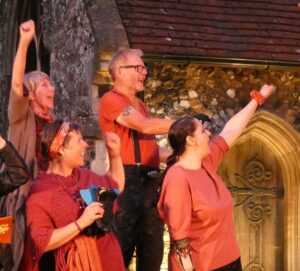
This article was first published in the Autumn 2026 edition of Wivenhoe News.
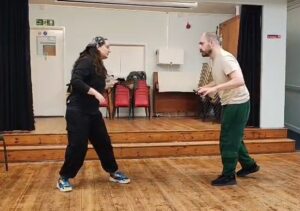
From Zero to Stabbing in three hours – don’t try this at home!


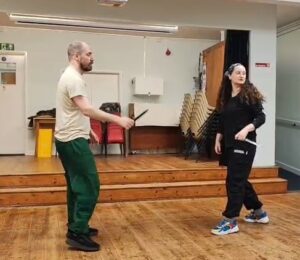
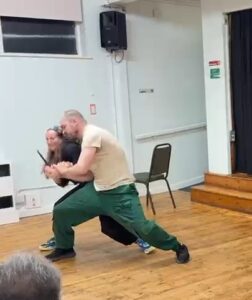
As part of the rehearsal process for Richard II, our director Nora Williams arranged for us to have a visit from stage combat experts Wandering Knights.   Luke and Lucy gave a fight workshop to the whole cast and then concentrated on choreography of the main action scene in the play. 

After some warm-up exercises, we were divided into pairs and taught how to safely push one another in a way that looks dramatic, but involves very little pressure and puts the ‘victim’ in control as they stagger convincingly backwards.  This was followed by some authentic-looking slaps to the face, complete with sound effect. Next step was a punch which seemed to land with a heavy thump, with the victim reeling backwards.  And all achieved with no physical contact and a safe distance between the combatants.   We were then entrusted with some deadly-looking daggers – plastic, but still needing to be handled with care.  We learnt how to slash at the enemy – and how to react to a slash – before moving on to some scary stabbing.  We discovered that the illusion is usually in the response of the victim – often the dagger can actually be nowhere near them, but if the reaction is true to life, the onlooker will be fooled, and even gasp in horror.  They also taught us that slow-motion is our friend, maintaining the tension and holding the audience’s attention better than fighting at speed.

Looking around the room, it was fascinating to see fellow cast members – of all ages, genders, heights and levels of fitness, engaged in snarling, vicious confrontations.  We came away exhausted but invigorated, with a new skill under our belts.  Luke and Lucy were engaging, patient teachers and demonstrators who delivered two fun sessions and we are looking forward to putting their training into practice.   I will pass on their parting message, though, which was: Don’t try this at home!


Meeting Nora Williams – in conversation with Diane Spivey

Hello Nora!

Welcome to Wivenhoe Open-Air Shakespeare as our new director for 2026 – we are looking forward to getting to know you. What made you want to direct a play for our group?

Thank you so much for inviting me to be involved! I am so excited to have the opportunity to direct this play, with this group of people. Community theatre is more important than ever in our age of AI and misinformation and suspicion of our neighbours. Getting people together to create something, and sharing that with the community, is one of the most important things we can do. I love the way that WOAS incorporates music into their shows, too, and I appreciate your track record of performing Shakespeare’s less popular plays. I really enjoyed All’s Well That Ends Well this past summer, and I can’t wait to get stuck in with Richard II.

Why Richard II?

Shakespeare’s history plays are underrated, and Richard II, in particular, is more than meets the eye. My friend Dr Ambereen Dadabhoy compares this play to Mean Girls – there’s a lot of general cattiness that is so much fun. At the same time, there’s a great deal of salience in this story for the modern world: incompetent and selfish leadership and political squabbling are front and centre, and both Richard and Bolingbroke are flawed as leaders. If you’re a lower-class character in this story – or even one of the more minor lords – it feels like there are no good outcomes. Imagining Richard as a direct analogue for, say, Donald Trump is over-simplifying things – but those contexts are certainly present when I look at what this play might have to say today.

Why is it a good play to get involved in as cast or crew?

I love this script because there’s truly a part for everyone – there are about 40 characters, depending on how you count the soldiers and servants. If you’re nervous about having lots of lines, we’ve got you covered! But, equally, if you’re keen to take on a challenge, this play has some of the most beautiful poetry. I’m contemplating some gender play with a couple of the key characters – specifically Bolingbroke – so watch this space!

What is your background, and what inspired your passion for Shakespeare and his plays?

I benefitted from the vibrant local theatre scene in my hometown of Buffalo, New York. One of my first gigs as a teenager was with Shakespeare in Delaware Park, Buffalo’s equivalent of WOAS, which celebrated its 50th season this year!  I went on to drama school in Toronto, before moving to the UK to pursue a masters in Staging Shakespeare at Exeter. From there, I applied for PhD funding mostly so I could keep hanging out with this cute British guy… I don’t recommend it to young people as a life plan, but it worked out for us! We’ve been married seven years this year. Currently, I work for BIMM University, a small and specialist institution focused on the creative industries.  Recently I’ve been directing A Two Woman Hamlet – we’ll be at Colchester Fringe 24-29 October https://colchester.ssboxoffice.com/events/a-two-women-hamlet/

How would you define your style of direction? What are your hopes for the whole process of rehearsing and performing?

I’m a highly collaborative director – I’ll have my toolbox of techniques and approaches, but what I really want to know is what the actors and the creative team are going to bring into the room. My favourite phrase in rehearsal is, ‘let’s try it’. I love being in a room where I’m surprised by the actors, and I do my best to create a space where we’re all empowered to take those creative risks and challenge ourselves. Overall, I hope that we’ll have a lot of fun, we’ll all learn something new, and we’ll put together a great show.

Do you act as well as direct?  Do you have a favourite Shakespeare character or play?

I don’t do so much acting anymore, although I sing with Colchester Choral Society. My favourite character and my favourite play from the early modern period are actually not written by Shakespeare. I love Moll Cutpurse from Thomas Middleton and Thomas Dekker’s The Roaring Girl – she’s fascinating and fun to play. My favourite play at the moment is William Rowley, Thomas Dekker, and John Ford’s true-crime tragicomedy The Witch of Edmonton.

Tell us something else about yourself that we might not know.

I recently published my first book! Canonical Misogyny: Shakespeare and Dramaturgies of Sexual Violence came out with Edinburgh University Press in late 2024.

Richard II will be performed in St Mary’s Churchyard, Wivenhoe at the end of June 2026. Read-throughs and auditions will be in February/March 2026. Follow our Facebook page or contact us for further details.