Why not lead a workshop? or How we planned ‘What country, friends, is this?’ by Helen Chambers

    The New Map

During All’s Well, last summer, Diane and I joked that Shakespeare’s geographical knowledge left a lot to be desired: how could Helen’s pilgrimage from France to Santiago de Compostella bring her to Florence? When we agreed to run a workshop together (I highly recommend working with someone) we decided to investigate the theme of travel in some of his plays. We dug up new scenes and revisited old favourites which fitted the bill – there were so many to choose from.

I really enjoyed my light research around the topic (thanks to Google). My historical knowledge is narrow and patchy, and what I found out about travel in Shakespeare’s time really opened my mind.

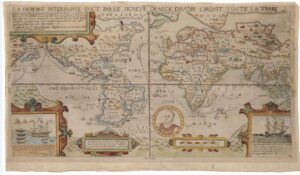
In 1580, when Shakespeare was an impressionable 16-year-old, Sir Francis Drake completed his circumnavigation of the globe – the first by an Englishman. Suddenly, the world looked different. You could compare it to the Space Race in terms of the impact on thought, scientific discovery, politics, religion, commerce and exploration. Certainly, Shakespeare’s plays reflected the hot topics of the day. He didn’t need to be accurate; he would have known more than most of his audience.

He named his new theatre, on the banks of the bustling Thames, ‘The Globe’ (catchier than ‘The Theatre’ or ‘The Curtain’) and he would have mixed with traders and travellers, carrying exotic goods and telling fantastic tales, perfect to fire a writer’s imagination. Trade combined adventure and big business: the coffers of Elizabeth I were drastically swelled with Spanish silver Drake had ‘collected’ en route!

Once you start looking for references in the plays, they’re everywhere:

I’ll put a girdle round about the earth in forty minutes – Puck, A Midsummer Night’s Dream.

 We the globe can compass soon – Oberon, A Midsummer Night’s Dream.

 She is spherical like a globe – Dromios’s (xenophobic) tour of countries around the body of Nell the maid in Comedy of Errors

I also gained a fuller understanding of the enormity of the loss of Antonio’s ships in The Merchant of Venice.

 Also new and exciting at the time were books of maps – for armchair students, rather than as navigational tools. An early one was named The Theatre of the Lands of the World. It’s easy to see where the All the world’s a stage speech may have originated.

I thoroughly recommend the following BBC Radio 4 series, which I found hugely informative: https://www.bbc.co.uk/sounds/series/b017gm45?partner=uk.co.bbc&origin=share-mobile

I also thoroughly recommend planning and running a workshop. It’s a great way to delve deeper into Shakespeare’s writing!
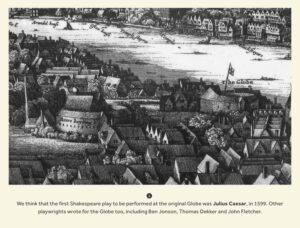
The Globe Theatre

What country, friends, is this? A Shakespeare quiz from Diane Spivey and Helen Chambers

If you missed our workshop on Shakespeare and Travel, here is your chance to try your hand at the quiz we devised.  Scroll down below the questions for the answers – how did you get on?

WHAT COUNTRY, FRIENDS, IS THIS?

Quiz questions

  1. Outside which French town does Henry V deliver his speech: “Once more unto the breach, dear friends, once more, Or close the wall up with our English dead!”? a) Agincourt; b) Calais; c) Harfleur

2. Which Welsh town did Imogen, dressed as a boy, manage to reach after only two days’ riding from London when, in reality, it would have taken nearly a fortnight? a) Flint; b) Milford Haven; c) Harlech

3.  In Two Gentleman of Verona, which land-locked city do Valentine and Proteus sail to by boat?        a) Milan; b) Rome; c) Florence

4.  Which unlikely bear-infested coastline does Antigonus get shipwrecked on?   a) Illyria; b) Bohemia; c) Ephesus

5. Which castle in a notably flat location has (according to Shakespeare) a “dreadful summit of the cliff, That beetles o’er his base into the sea”?                   a) Pomfret; b) Cawdor; c) Elsinore

6.  The majority of Shakespeare’s plays (thirteen) are set primarily in England. Twelve plays are set in which location, making it the next most popular?                a) France; b) Italy; c) Greece

7.  Which of these countries is not used by Shakespeare as a setting for any of his plays?  a) Austria; b) Egypt; c) Ireland

8.  Have you heard the one about the Englishman, the Scotsman, the Irishman and the Welshman? In which Shakespeare play do these four characters converse?  a) Macbeth; b) The Merry Wives of Windsor; c) Henry V   (bonus point if you can name them!)

9.   Which of these ancient Eastern Mediterranean cities is not visited in the play Pericles?     a) Tyre; b) Alexandria;  c) Antioch

10.  Which Shakespeare play is set entirely in Spain?  a)Two Noble Kinsmen; b) Love’s Labour’s Lost; c) Measure for Measure

11.  Which of these Shakespeare characters does not come from Athens?                    a) Timon; b) Theseus; c) Achilles

12.  Three of Shakespeare’s history plays take place entirely in England. Which of the following also has action that takes place outside England?                                   a) Henry IV part 1; b) Henry VIII; c) Henry VI part 2      (bonus point for saying where!)

Answers below (no peeking!)


  1. c. Harfleur (siege of Harfleur) Henry V

2.b. Milford Haven (250 miles at 20 miles a day by horse – or 4 hrs 50 by car down the M4) Cymbeline

3.a. Milan (Verona is also land-locked) Two Gentlemen of Verona

4.b. Bohemia (now Czech Republic with no sea-coast) A Winter’s Tale

5.c. Elsinore (Denmark, speech by Horatio on castle battlements) Hamlet

6.b. Italy (France 6, Greece 4, Roman Empire 3 – others are single plays)

7.c. Ireland (in various plays characters come from or go to Ireland but no play set there)

8.c. Henry V (Gower-English, Fluellen-Welsh, Capt. Jamy-Scottish, Capt. MacMorris-Irish)

9.b. Alexandria (other locations include Tarsus, Ephesus, Pentapolis)

10.b. Love’s Labour’s Lost (Kingdom of Navarre – but characters include Princess of France)

11.c. Achilles (Troilus & Cressida) is from Phthia in Greece. Theseus Duke of Athens appears in both A Midsummer Night’s Dream and Two Noble Kinsmen.

12.a. Henry IV part 1 (scene set in Bangor, Wales)