Courtly Masques and Historical Dances – Out dancing on a Friday Night by Lesley Duncan

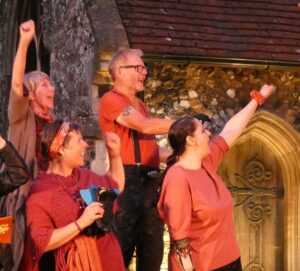
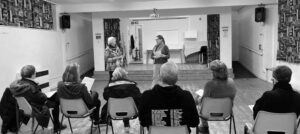
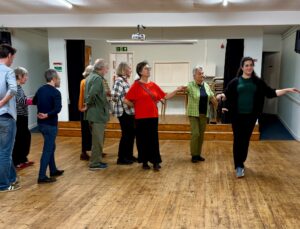
On a Friday night at the beginning of October,  Wivenhoe Open Air Shakespeare’s workshop drew a large number of regulars and many new faces to the Congregational Church Hall, all willing to step onto the dance floor. After all, what did the odd octogenarian or two have to fear from a pavane?

Nora Williams, who was leading the workshop, gave us an introduction to the renaissance masque and the courtly practices of Elizabeth I. We were   reminded of the historical dances used in familiar TV costume dramas and theatrical Shakespeare productions, and we were ready to go!
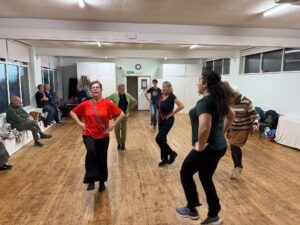
First came the traditional Sellenger’s Round. Oh yes, stepping the eight-count sequence to William Byrd’s lute melody was ultimately manageable and appropriate fun for a Shakespeare workshop. Now we became Queen Nora’s court and giving a courtly bow, set out to wow her with our pavane. Imagining our wide-panniered dresses with their large bum rolls, we were soon tripping lightly (well, some of us), as Dowland’s Lachrimae led us around the hall. Hold on a minute, a faster pavane, and now we had to reverse step? A timely tea break arrived.
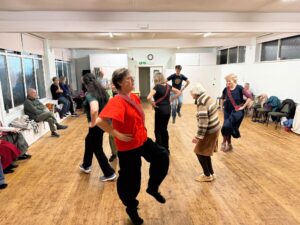
Nora now introduced us to the galliard. This was a chance for the gentlemen of court to display their athleticism and fine calf – provoking the odd participant to inspect under a raised trouser leg. Having given us an impressive display of hop-step variations, Nora challenged us to create our own routines. It was a relief to many that the woman partner merely had to maintain a constant six beat, thank heavens no feet could be seen under those capacious dresses!
We learnt that the court was also a place for fun and frolics, the volta requiring the man to firmly grasp his partner’s bum roll, and, with an indelicate knee between her legs, hoist her into the air. Perhaps it was just as well there was no time left to explore further dances! It was an evening full of fun, facts and surprises. Thank you, Nora, for sharing your skills and enthusiasm, we are very fortunate to have the opportunity to work with you.
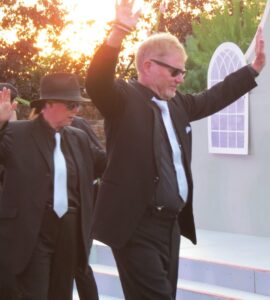
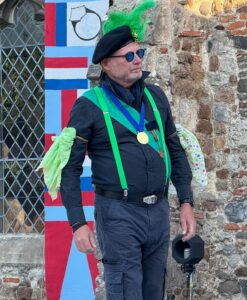
The Barred Bard by John O’Brien

Shakespeare walked into a pub…

…And the landlord said “Get out,  you’re Bard.”

She didn’t laugh.  In truth she was a little fed up of me returning from my Friday bike ride a bit worse for wear, after rehydrating in the pub. “Why don’t you go to these Shakespeare Workshops, held every Friday evening by the erudite members of the Wivenhoe Open Air Shakespeare Group?  You might learn something”. The idea did appeal to me.  The little I knew about Shakespeare’s plays came from English O level, more than half a century earlier, and a workshop sounded about right. I wouldn’t be expected to read, or act or humiliate myself in a new and unforeseen way, would I?

That was over three years ago and since then I have appeared in three successive productions. In the first (Much Ado about Nothing) I played a drunken thug called Borachio, the second (All’s Well That Ends Well) saw me tread the boards as a cowardly, preening thug called Parolles and in the latest production of Richard II,  I played Northumberland: a thug. After each play, I have sworn never to do that again. So, what is it that causes me to return to the scene of so much personal angst?

The simple answer is, of course, my fellow players and the camaraderie you feel when a diverse group of people strive together to produce an event, perfect a product, score a goal.

The process feels very similar to playing for a football team. It starts with knowing the objective. What play is going to be performed?  Who will play in each position?  Do we have faith in the manager?  Then comes the bi-weekly training, the self-doubt, the learning from others, the being match-fit and, of course, the singing.  

Nothing would happen without a back-room team that makes it all happen. Everyone joins in with that. The kit (costumes), preparing the playing field (the stage), crowd control (front of house), the stands (white plastic chairs do not appear by magic) and a hundred and one things that are necessary to make a premier division team. Including regular sessions with a counsellor (going to the pub)!

Eventually, we have a week of cup finals. The atmosphere in the changing room is febrile, lots of pacing about and worried looks.  Finally we march out behind the band and the crowd goes wild claps politely. And so it begins. We have our individual stars, of course. Those personalities who can turn the game on its head with a simple sneer, or an archly-raised eyebrow, but it’s teamwork that wins the day – five nights in a row.   I do think that after the week of shows we should tour Wivenhoe in an open-top bus.

In short, the WOAS group is a friendly, hardworking, supportive, talented group of individuals who join together to create a team capable of winning the world cup.

I wonder if there are any roles for a thug in next summer’s King Lear?

This article was first published in the Autumn 2026 edition of Wivenhoe News.

Why not lead a workshop? or How we planned ‘What country, friends, is this?’ by Helen Chambers

    The New Map

During All’s Well, last summer, Diane and I joked that Shakespeare’s geographical knowledge left a lot to be desired: how could Helen’s pilgrimage from France to Santiago de Compostella bring her to Florence? When we agreed to run a workshop together (I highly recommend working with someone) we decided to investigate the theme of travel in some of his plays. We dug up new scenes and revisited old favourites which fitted the bill – there were so many to choose from.

I really enjoyed my light research around the topic (thanks to Google). My historical knowledge is narrow and patchy, and what I found out about travel in Shakespeare’s time really opened my mind.

In 1580, when Shakespeare was an impressionable 16-year-old, Sir Francis Drake completed his circumnavigation of the globe – the first by an Englishman. Suddenly, the world looked different. You could compare it to the Space Race in terms of the impact on thought, scientific discovery, politics, religion, commerce and exploration. Certainly, Shakespeare’s plays reflected the hot topics of the day. He didn’t need to be accurate; he would have known more than most of his audience.

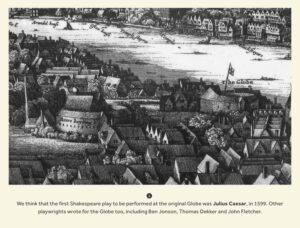
He named his new theatre, on the banks of the bustling Thames, ‘The Globe’ (catchier than ‘The Theatre’ or ‘The Curtain’) and he would have mixed with traders and travellers, carrying exotic goods and telling fantastic tales, perfect to fire a writer’s imagination. Trade combined adventure and big business: the coffers of Elizabeth I were drastically swelled with Spanish silver Drake had ‘collected’ en route!

Once you start looking for references in the plays, they’re everywhere:

I’ll put a girdle round about the earth in forty minutes – Puck, A Midsummer Night’s Dream.

 We the globe can compass soon – Oberon, A Midsummer Night’s Dream.

 She is spherical like a globe – Dromios’s (xenophobic) tour of countries around the body of Nell the maid in Comedy of Errors

I also gained a fuller understanding of the enormity of the loss of Antonio’s ships in The Merchant of Venice.

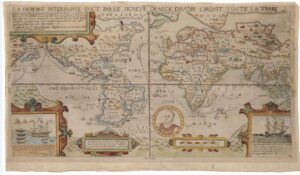
 Also new and exciting at the time were books of maps – for armchair students, rather than as navigational tools. An early one was named The Theatre of the Lands of the World. It’s easy to see where the All the world’s a stage speech may have originated.

I thoroughly recommend the following BBC Radio 4 series, which I found hugely informative: https://www.bbc.co.uk/sounds/series/b017gm45?partner=uk.co.bbc&origin=share-mobile

I also thoroughly recommend planning and running a workshop. It’s a great way to delve deeper into Shakespeare’s writing!

The Globe Theatre

What country, friends, is this? A Shakespeare quiz from Diane Spivey and Helen Chambers

If you missed our workshop on Shakespeare and Travel, here is your chance to try your hand at the quiz we devised.  Scroll down below the questions for the answers – how did you get on?

WHAT COUNTRY, FRIENDS, IS THIS?

Quiz questions

  1. Outside which French town does Henry V deliver his speech: “Once more unto the breach, dear friends, once more, Or close the wall up with our English dead!”? a) Agincourt; b) Calais; c) Harfleur

2. Which Welsh town did Imogen, dressed as a boy, manage to reach after only two days’ riding from London when, in reality, it would have taken nearly a fortnight? a) Flint; b) Milford Haven; c) Harlech

3.  In Two Gentleman of Verona, which land-locked city do Valentine and Proteus sail to by boat?        a) Milan; b) Rome; c) Florence

4.  Which unlikely bear-infested coastline does Antigonus get shipwrecked on?   a) Illyria; b) Bohemia; c) Ephesus

5. Which castle in a notably flat location has (according to Shakespeare) a “dreadful summit of the cliff, That beetles o’er his base into the sea”?                   a) Pomfret; b) Cawdor; c) Elsinore

6.  The majority of Shakespeare’s plays (thirteen) are set primarily in England. Twelve plays are set in which location, making it the next most popular?                a) France; b) Italy; c) Greece

7.  Which of these countries is not used by Shakespeare as a setting for any of his plays?  a) Austria; b) Egypt; c) Ireland

8.  Have you heard the one about the Englishman, the Scotsman, the Irishman and the Welshman? In which Shakespeare play do these four characters converse?  a) Macbeth; b) The Merry Wives of Windsor; c) Henry V   (bonus point if you can name them!)

9.   Which of these ancient Eastern Mediterranean cities is not visited in the play Pericles?     a) Tyre; b) Alexandria;  c) Antioch

10.  Which Shakespeare play is set entirely in Spain?  a)Two Noble Kinsmen; b) Love’s Labour’s Lost; c) Measure for Measure

11.  Which of these Shakespeare characters does not come from Athens?                    a) Timon; b) Theseus; c) Achilles

12.  Three of Shakespeare’s history plays take place entirely in England. Which of the following also has action that takes place outside England?                                   a) Henry IV part 1; b) Henry VIII; c) Henry VI part 2      (bonus point for saying where!)

Answers below (no peeking!)


  1. c. Harfleur (siege of Harfleur) Henry V

2.b. Milford Haven (250 miles at 20 miles a day by horse – or 4 hrs 50 by car down the M4) Cymbeline

3.a. Milan (Verona is also land-locked) Two Gentlemen of Verona

4.b. Bohemia (now Czech Republic with no sea-coast) A Winter’s Tale

5.c. Elsinore (Denmark, speech by Horatio on castle battlements) Hamlet

6.b. Italy (France 6, Greece 4, Roman Empire 3 – others are single plays)

7.c. Ireland (in various plays characters come from or go to Ireland but no play set there)

8.c. Henry V (Gower-English, Fluellen-Welsh, Capt. Jamy-Scottish, Capt. MacMorris-Irish)

9.b. Alexandria (other locations include Tarsus, Ephesus, Pentapolis)

10.b. Love’s Labour’s Lost (Kingdom of Navarre – but characters include Princess of France)

11.c. Achilles (Troilus & Cressida) is from Phthia in Greece. Theseus Duke of Athens appears in both A Midsummer Night’s Dream and Two Noble Kinsmen.

12.a. Henry IV part 1 (scene set in Bangor, Wales)

Money, Money, Money

Money, Money, Money (Shakespeare not Abba)

…was the title of our November 2024 workshop, led by me and Alison.

We began with an informal quiz:

Who said the following, and in which play? (Answers at the bottom)

    1. Have I not told thee how I was cozened by the way and lost all my money?
    2. I can compare our rich misers to nothing so fitly as to a whale: a’ plays and tumbles, driving the poor fry before him, and, at last devours them all at a mouthful.
    3. Money buys lands, and wives are sold by fate.
    4. If money go before, all ways do lie open.
    5. If thou wilt lend this money … lend it rather to thine enemy, who, if he break, thou mayst with better face extract the penalty.
    6. He that dies pays all debts.
    7. So sorrow’s heaviness doth heavier grow/ For debt that bankrupt sleep doth sorrow owe/ Which now in some slight measure it will pay/ If, for his tender, her I make some stay.
    8. For saying, there’s gold.
    9. Whiles I am a beggar, I will rail and say there is no sin but to be rich; and being rich, my virtue then shall be to say there is no vice but beggary.
    10. With a good leg and a good foot and money enough in his purse/ Such a man could win any woman in the word, if ‘a could get her good will.
    11. Nor would we deign him burial of his men/ till he disbursèd at St Colme’s Inch/ Ten thousand dollars to our general use.
    12. He that wants money, means and content, is without three good friends.
    13. If any Syracusan born/ Come to the bay of Ephesus, he dies/ His goods confiscate to the Duke’s dispose/ Unless a thousand marks be levied/ To quit the penalty and to ransom him.
    14. But the comfort is, you shall be called to no more payments, fear no more tavern bills.


Answers (they’re all from plays performed by WOAS!)

    1. Young Shepherd, The Winter’s Tale 4.4.278
    2. 1st Fisherman, Pericles 2.1.30
    3. Ford, Merry Wives of Windsor 5.5
    4. Ford, Merry Wives 2.2
    5. Antonio, Merchant of Venice 1.3
    6. Stephano, The Tempest 3.2
    7. Demetrius, A Midsummer Night’s Dream 3.2.84
    8. Olivia, Twelfth Night 1.2.18
    9. The Bastard, King John 2.1
    10. Beatrice, Much Ado About Nothing 2.1
    11. Ross, Macbeth 1.2 (the dollars in question may be ‘thistle dollars,’ created by King James!
    12. Corin, As You Like It 3.2.25
    13. Duke, The Comedy of Errors 1.1.18
    14. 1st Jailer, Cymbeline 5.4

How did you get on?!

Obviously money is a key theme in many plays – and the related vocabulary  appears in all of them!

Helen